This guide helps beginner gardeners choose an organic vegetable seed kit that suits their planting space and local growing season, then sow the seeds and care for them. You will finish with labeled containers, seeds planted at suitable depths, and a simple plan for watering and checking germination. Allow about 1–2 hours for selection and setup; seedlings may take days or weeks to appear, depending on the crop.

Get garden gear delivered free — and shop member deals
- Fast, free delivery on millions of items
- Access to Prime Big Deal Days deals on October 6–7
- Prime Video, Amazon Music and more included

55-Variety Non-GMO Heirloom Vegetable Seed Pack with 35,600+ Seeds
- ✔ Varieties: 55
- ✔ Total seeds: 35,600+
- ✔ Seed description: Non-GMO heirloom; organic certification not specified
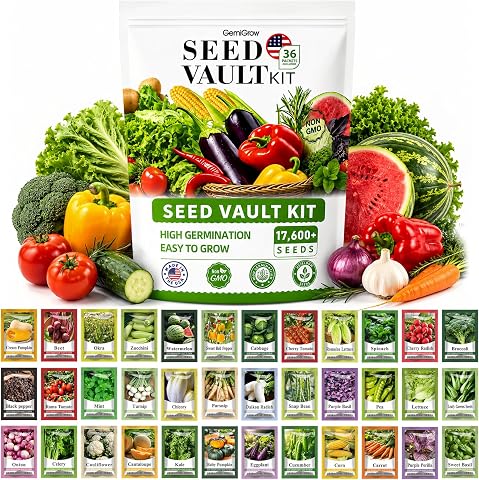
GermiGrow Vegetable and Fruit Seed Vault Kit, 17,600+ Heirloom Seeds, 36 Non-GMO Varieties
- ✔ Varieties: 36
- ✔ Total seeds: 17,600+
- ✔ Crop mix: Vegetables and fruit

75-Variety Medicinal and Tea Herb Seed Starter Kit with Gardening Tools
- ✔ Varieties: 75 herb varieties
- ✔ Total seeds: Over 47,380
- ✔ Seed description: Non-GMO heirloom; organic certification not specified
Difficulty: Beginner | Time: 1–2 hours to choose a kit and sow seeds; several weeks of follow-up care
What You’ll Need
Tools & Materials:
- Organic vegetable seed kit with seed packets and any included instructions
- Seed-starting trays, small pots, or clean containers with drainage holes
- Seed-starting mix or a suitable fine-textured potting mix
- Watering can with a gentle rose, spray bottle, or clean cup
- Plant labels and a waterproof marker
- Light source, such as a sunny window or a grow light
- Thermometer, optional but helpful for checking growing temperatures
Knowledge:
- Basic ability to read a seed packet and follow measurements
- A general idea of whether seeds will grow indoors or be sown outdoors
- Access to local frost dates or a regional planting calendar
Check which crops are included before opening the packets. Compare each crop’s sowing time, days to maturity, and light needs with your location and available space. Organic certification applies to the seed production standard stated on the package; it does not mean the seeds are treated as a complete growing system or guarantee a harvest. Use new or thoroughly cleaned containers, and do not use garden soil in small indoor pots because it can drain poorly.
55-Variety Non-GMO Heirloom Vegetable Seed Pack with 35,600+ Seeds
This is our leading choice when the priority is vegetable variety in one kit. Its 55 individual packets and stated total of more than 35,600 seeds give gardeners room to try a broad range of crops, while the included clipper, seed dibber, weeding fork, tweezers, and widger make it more immediately equipped than GermiGrow. A waterproof resealable bag is also a practical way to keep packets together between planting sessions.The kit’s central limitation is that non-GMO heirloom does not establish organic certification; buyers specifically requiring certified organic seed should verify certification with the seller before ordering. The claimed germination rate is likewise a seller statement, not an independently substantiated result in the supplied details. Compared with GermiGrow, this pack has more varieties and tools, but its growing and culinary guides require QR scans rather than arriving as clearly described printed material. The seller also gives a broad year-round planting window, which should not replace checking crop-specific timing for your climate.We would choose it over the herb kit for a vegetable garden, but not simply because its packet count is high. Confirm which crops are included and whether they fit your space; the listed partial-sun exposure and general eight-inch height do not tell us the needs of every variety in a 55-crop assortment.
Pros:
- 55 vegetable varieties in individual packets
- Includes several small planting and weeding tools
- Waterproof resealable storage bag helps keep packets organized
- Described for indoor and outdoor growing
Cons:
- Organic certification is not established by the supplied non-GMO and heirloom claims
- Guides require QR scanning, and the stated germination rate is a seller claim
- Broad planting and sunlight details may not suit every variety in the assortment
Best for: Gardeners seeking a broad, vegetable-first seed assortment with individual packets and a starter set of small tools.
Not ideal for: Buyers who need documented organic certification, want printed guides, or need crop-by-crop growing and sunlight information before purchase.
Bottom line: We rank this first for vegetable breadth and included tools, provided buyers verify organic status and check the crop-specific growing details.
“We rank this first for vegetable breadth and included tools, provided buyers verify organic status and check the crop-specific growing details.”
GermiGrow Vegetable and Fruit Seed Vault Kit, 17,600+ Heirloom Seeds, 36 Non-GMO Varieties
GermiGrow suits buyers who want a smaller, mixed crop collection rather than the largest vegetable assortment. It lists 36 heirloom, non-GMO vegetable and fruit varieties, with more than 17,600 seeds, individual packs, planting guides, and growing tips. That gives it a useful advantage over the 55-variety pack for shoppers who value guidance included with the seeds instead of relying entirely on QR-linked material.Its stated suitability for indoor, outdoor, greenhouse, and hydroponic growing sounds flexible, but the listed full-shade sunlight exposure is a point to clarify. Sun requirements are crop-specific, so we would not assume every listed variety will thrive in shade or in every environment named. The product details also provide less information about accessories and storage than the first-ranked kit. In exchange for fewer varieties and no described tool bundle, GermiGrow offers a vegetables-and-fruit angle that may better match gardeners who want more than vegetables alone.As with the top pick, its non-GMO and heirloom descriptions are not proof of organic certification, and its 90%-or-higher germination figure is stated rather than verified here. We would choose it when the included guides and fruit component matter more than maximum variety count, after confirming the light requirements for the specific seed packets.
Pros:
- 36 varieties combine vegetables and fruit
- Includes individual seed packs, planting guides, and growing tips
- Described for indoor, outdoor, greenhouse, and hydroponic use
- USA-grown origin is stated
Cons:
- Organic certification is not specified in the supplied product information
- Full-shade exposure may conflict with the needs of some included crops
- Germination rate is a product claim, and accessories are not detailed
Best for: Gardeners who want a moderate-size vegetable-and-fruit assortment with planting guidance and several stated growing-environment options.
Not ideal for: Buyers seeking the broadest vegetable-only selection, a tool bundle, or confirmed organic certification and crop-specific light details.
Bottom line: Choose GermiGrow over the larger vegetable pack when its fruit mix and included guidance matter more than maximum variety and tools.
“Choose GermiGrow over the larger vegetable pack when its fruit mix and included guidance matter more than maximum variety and tools.”
75-Variety Medicinal and Tea Herb Seed Starter Kit with Gardening Tools
This kit has the highest variety count in the lineup, but the key distinction is that it is a medicinal and tea herb collection, not a vegetable seed kit. Its 75 non-GMO heirloom herb varieties and stated total of more than 47,380 seeds may suit someone building an herb garden alongside vegetables. The wooden storage box and assortment of accessories, including a seed dispenser, claw gloves, mini tools, pH strips, and a UV-protective cap, make it a more accessory-heavy package than GermiGrow.For a shopper whose main goal is growing vegetables, however, the variety count can be misleading: herbs do not replace vegetable crops. We therefore rank it third for this roundup, despite its breadth and longer stated storage viability. The listing says seeds may remain viable for up to three years when stored properly, which places more importance on cool, dry, airtight storage than the included box alone may suggest. Its partial-sun and moderate-watering specifications also may not match every growing space or every herb.Choose this kit as a complement to the 55-variety vegetable pack or GermiGrow, not as a substitute. As with the other products, non-GMO and heirloom descriptions do not confirm organic certification, and the reported germination figure is not independently verified in the details provided. Buyers should also check whether its herb selection and growing instructions fit their intended uses.
Pros:
- 75 herb varieties and more than 47,380 seeds are stated
- Includes a wooden storage box and several gardening accessories
- Described for indoor and outdoor growing
- Up to three years of viability is stated with proper storage
Cons:
- Herbs rather than vegetables, so it does not fulfill a vegetable-first need
- Organic certification is not specified; germination figure is reported rather than verified
- Maintaining seed viability depends on proper storage, and partial sun may not fit every space
Best for: Gardeners who already have vegetable seeds and want a wide selection of tea and medicinal herbs with storage and gardening accessories.
Not ideal for: Anyone looking for a primary vegetable seed kit, documented organic certification, or crops suited to a specific light and watering setup.
Bottom line: We recommend this as an herb-garden add-on, not as a direct alternative to the two vegetable-containing kits.
“We recommend this as an herb-garden add-on, not as a direct alternative to the two vegetable-containing kits.”
As an Amazon Associate we earn from qualifying purchases.
Before You Start
Find your local average last frost date if you plan to grow warm-season crops such as tomatoes, peppers, or squash. Seed packets usually say how many weeks before or after frost to sow. Cool-season crops, including lettuce and some brassicas, may have different timing. Follow the instructions for each variety rather than sowing every packet at once. Set aside only the seeds you can grow in your available beds or containers, and keep unused packets sealed in a cool, dry place.
Check that indoor containers drain and that seedlings can receive strong light. A dim window can produce weak, stretched plants; a grow light may be needed. Wash your hands and work surface, especially if you are reusing containers. Do not let seed-starting mix or labels obscure the crop name and variety.
Step-by-Step Instructions
Step 1: Match the kit to your growing space
Read the kit’s crop list and choose a kit whose vegetables fit the space you actually have. For a balcony or patio, look for crops suited to containers and check the mature plant size and pot depth. For an in-ground bed, check each crop’s spacing and total bed area. If you are new to gardening, favor a manageable number of varieties rather than a large assortment you cannot plant or maintain.
Check the package for organic certification details, seed quantities, variety names, and sowing instructions. Compare the varieties’ stated days to maturity with your local growing season. If a crop needs a longer season than your region provides, choose a shorter-season variety or plan to start it indoors as directed.
Tip: A kit labeled organic may still include crops that are unsuitable for your climate or space. Use the seed packet directions and local planting calendar to make the final choice.
Check: You can name where each selected crop will grow and confirm that its season and space needs fit your plan.
Step 2: Sort seeds by sowing time
Lay out the packets and group them by when they should be sown: indoors before the last frost, directly outdoors after frost, or directly outdoors during cooler weather. Read the packet for each crop, including sowing depth, spacing, light, temperature, and whether the crop resents transplanting. Write the sowing window and intended location beside the variety on a simple planting list.
Set aside packets that are not yet in season. Keep them closed and store them in a cool, dry place away from sunlight, heat, and moisture. Do not assume that all seeds in a kit should be planted together.
Tip: If packet directions and a general planting calendar differ, follow the packet’s crop-specific instructions and adjust for your local frost dates.
Check: Each packet you plan to sow has a clear timing category and a chosen indoor or outdoor location.
Step 3: Prepare containers and growing mix
Wash reusable trays or pots with soap and water, rinse them, and confirm that excess water can drain. Fill containers with moist seed-starting mix, leaving a small gap at the top. Moisten the mix before sowing so it is evenly damp, not dripping. If sowing outdoors, prepare the bed by removing weeds and loosening the surface as the seed packet recommends.
Do not pack the mix down hard. A firm but loose surface lets seeds make contact with moisture while allowing small roots and shoots to develop.
Tip: Place indoor trays on a waterproof surface before filling them. This limits spills and makes it easier to water from below if your tray design allows it.
Check: Containers are clean, labeled space is available, and the growing mix is evenly moist with no standing water.
Step 4: Label each variety before sowing
Write the crop name and variety on a plant label with a waterproof marker. Add the sowing date and, if useful, the planned transplant date. Put a label in each pot, cell, or clearly separated row before you add seeds. If you sow several varieties in a shared tray, make a simple map and label the tray as well.
Tip: Seedlings of different vegetables can look alike at first. Do not rely on memory or on keeping packets beside the tray; packets can be moved or misplaced.
Check: Every container or row can be linked to a crop, variety, and sowing date without guessing.
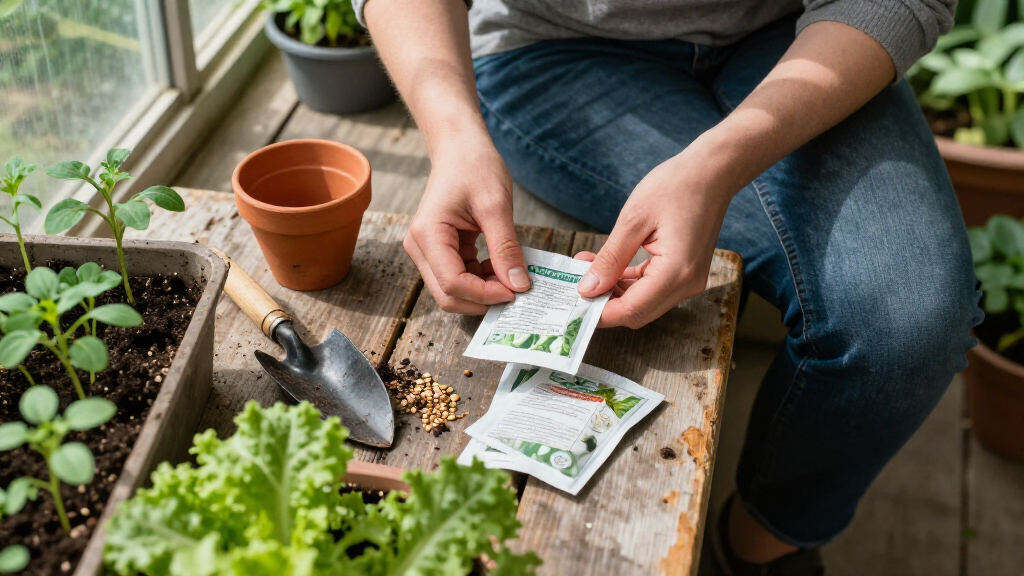
Step 5: Sow seeds at packet depth
Use the seed packet’s depth and spacing directions. Make a shallow hole or furrow, place the recommended number of seeds, and cover them with the stated amount of mix or soil. Very small seeds may need to be pressed gently onto the surface rather than buried; follow the packet. If the packet gives no depth, a common starting guide is to sow a seed about twice as deep as its width, but tiny seeds often need light or very shallow coverage.
Sow a few extra seeds only when you have room to thin seedlings later. Avoid crowding cells, which can lead to tangled roots and make watering and transplanting harder. Water gently after sowing so seeds stay in place.
Tip: Do not use one depth for every crop. Seeds buried too deeply may fail to emerge, while surface-sown seeds can dry out if their packet calls for covering.
Check: Seeds are covered or surface-sown as directed, and labels remain in place after watering.
Step 6: Set the right conditions for germination
Place indoor containers where they can receive the temperature and light conditions listed on the packet. Keep the mix consistently moist but not waterlogged. Cover trays with a clear dome or loose plastic only if it helps retain moisture, and remove the cover when seedlings emerge so air can circulate. For outdoor sowing, water the bed gently and protect seeds from heavy rain, birds, or drying wind when needed.
Check containers daily. Water when the surface begins to dry, using a gentle flow so seeds and young shoots are not displaced. Do not leave trays sitting in water for long periods.
Tip: Some seeds germinate best with warmth, but most newly emerged seedlings need strong light. Follow crop-specific directions rather than leaving every tray on a heat source.
Check: The mix stays moist rather than saturated, and the containers are in a place that fits the crop’s temperature and light needs.
Step 7: Thin and care for emerged seedlings
Check the seed packets for expected germination time and look for seedlings without disturbing the soil. Once seedlings emerge, provide strong light and turn window-grown containers if the light comes from one side. When seedlings form true leaves, thin crowded plants by snipping weaker stems at soil level, leaving the strongest seedling at the spacing recommended for the container or crop.
Water when the mix begins to dry, and keep air moving around seedlings. If the packet recommends transplanting, wait until the plants are sturdy and outdoor conditions suit the crop. Harden indoor seedlings by gradually exposing them to outdoor conditions over several days before planting them outside.
Tip: The first pair of leaves are usually seed leaves; true leaves appear afterward and resemble the crop’s mature foliage more closely. Avoid pulling crowded seedlings, which can disturb the roots of the one you keep.
Check: Seedlings have room to grow, are not leaning or collapsing, and are receiving suitable light and moisture.
Common Mistakes to Avoid
- Sowing every seed in the kit at the same time. — Sort packets by sowing window and plant only crops that fit the current season and available space.
- Planting seeds too deeply or at uniform depth. — Read each packet and set the depth separately for each crop; tiny seeds may need surface sowing.
- Keeping seed mix constantly soggy. — Use containers with drainage, check moisture daily, and water gently when the mix starts to dry.
- Leaving varieties unlabeled. — Label each pot or row before sowing, including the variety and date.
Troubleshooting
Problem: No seedlings appear by the expected time.
Solution: Check the packet’s germination range, then confirm that the mix has stayed moist and the temperature suits the crop. If conditions were unsuitable, sow fresh seeds in correctly prepared mix. Do not dig through the tray repeatedly; that can damage seeds that are starting to germinate.
Problem: Seedlings emerge tall, pale, or leaning.
Solution: Move them to stronger light or lower a grow light according to its instructions. Keep light close enough to prevent stretching without overheating leaves, and rotate trays if light comes from one side.
Problem: Seedlings collapse at soil level.
Solution: Remove affected seedlings, improve airflow, and avoid waterlogged mix. Clean reused containers before starting again, and water the mix rather than keeping leaves and stems wet.
Problem: Seeds wash out of place during watering.
Solution: Use a spray bottle, fine-rose watering can, or bottom watering where appropriate. Re-cover displaced seeds at the packet’s depth and replace any label that moved.
What Success Looks Like
You have a kit matched to your space and season, a planting list tied to packet directions, and containers or rows labeled with crop, variety, and date. Seeds are sown at the stated depth in moist, draining mix or prepared soil. During follow-up, you can see seedlings emerge within the packet’s expected range, remain upright under suitable light, and develop without standing water or severe crowding. Some seeds may not germinate; success means following the packet, checking conditions, and resowing where needed rather than expecting every seed to sprout.
Next Steps
Record which varieties germinate and note the dates, so you can adjust future sowing. Keep unused seeds sealed and dry, and write the opening date on each packet. When seedlings are ready for outdoor planting, harden them off gradually and transplant them at the spacing on the packet. Continue to water according to weather and soil moisture, and check plants regularly for pests or signs of stress. If a crop fails, review its timing, temperature, light, and watering before using more seeds.
Frequently Asked Questions
What makes a vegetable seed kit organic?
Look for an organic certification or clear statement on the packaging that explains the seed-production standard. Organic seed refers to how the seed was produced; it does not guarantee germination or certify your later gardening practices by itself.
Can I plant every seed in the kit in containers?
Only if each crop’s mature size and root needs suit the containers you have. Check packet spacing and container guidance. Large or sprawling crops may need deep pots, more room, or a garden bed.
Should I start all vegetable seeds indoors?
No. Some crops are normally sown directly outdoors, and some do not handle transplanting well. Follow each packet’s directions for indoor starting or direct sowing.
How long do organic vegetable seeds take to germinate?
Germination time varies by crop, variety, temperature, and moisture. Use the range printed on the packet, and check that the mix and temperature match its directions before deciding that seeds have failed.
Can I save seeds from vegetables grown from the kit?
It depends on the variety and the crop. Open-pollinated varieties may produce plants similar to the parent when properly isolated and saved, while hybrid varieties may not. Check the packet and crop-specific seed-saving guidance before collecting seeds.
Halloween Picks
halloween
As an affiliate, we earn on qualifying purchases.