TL;DR
Thanksgiving outdoor string lights can make a porch, patio, or garden feel warm and welcoming after sunset. Measure the space, choose outdoor-rated lights and cords suited to their exposure, and use clips and manufacturer instructions to hang them safely. LEDs in warm white or amber are an easy seasonal choice, while solar lights may have shorter runtimes during November’s shorter days.
One November afternoon, you finish setting the table just as the sun slips behind the roofline. Outside, the pumpkins disappear into the dusk, and guests start feeling for the porch steps. A few carefully placed lights can change the whole scene: the pumpkins glow orange, the railing takes on a soft golden edge, and the walk to the door feels easier.

Get garden gear delivered free with Prime
- Fast, free delivery on millions of items
- Prime Video, Amazon Music and more included
- Member-only deals all year
This guide shows you how to choose Thanksgiving outdoor string lights, plan a layout that fits your space, and hang everything with autumn weather in mind. You’ll learn why LEDs suit many seasonal displays, when solar power can fall short, and how to keep cords and lights away from paths and dry leaves. A little measuring before you shop can save you from a sagging strand that stops two feet short of the outlet.
Measure the full route from the outlet to the final hook, including lead-cord distance and gentle dips.
Warm-white or amber LEDs pair easily with pumpkins, foliage, and a cozy Thanksgiving dinner.
November’s short days, shade, and cloudy weather can reduce solar-light charging and runtime.
Check outdoor ratings and instructions for every light, extension cord, and accessory in the setup.
Use suitable clips, inspect cords before installation, and keep lights clear of dry materials and walking paths.
Pick lights that fit your space and your Thanksgiving mood
For a cozy Thanksgiving display, start with warm white or amber LEDs and select a power source that matches where you’ll hang them. LEDs generally use less electricity and last longer than incandescent strings, while their golden color sits comfortably beside pumpkins, gourds, and autumn leaves. The right choice also depends on outlet access, weather exposure, and the feel you want at dinner.
Imagine a small porch with an outlet by the door: a plug-in strand can trace the railing without requiring you to replace batteries. For a fence across the yard, a battery-powered string may be simpler if you cannot safely reach an outlet. Solar lights can help in a sunny garden, though November’s shorter days and cloudy afternoons may leave them with less charge and a shorter evening glow. These choices affect more than convenience: plug-in lights offer steady power but require a safe cord route, batteries give you placement flexibility but need monitoring, and solar avoids a cord while making runtime depend on the day’s sunlight.
Recent decorative-lighting trends include app or remote controls, timers, dimming, color changes, and solar options. Features vary by product, so check that the controls and any accessories are suitable for outdoor use and the temperatures you expect. A remote can be handy when you want to dim the pergola during dinner; a basic warm-white string may be easier to manage if you only need a steady porch glow. More features can add useful control, but each is another compatibility detail to check and may not improve a display that only needs a simple on-and-off schedule.
For example, you might outline the porch in warm white, then use a small amber strand near a bowl of gourds. That gives your display a seasonal feel without burying the decorations in color. Think of the lights as the tablecloth for your outdoor scene: they bring everything together, but the pumpkins and people still deserve the spotlight. Keeping the main strand restrained also makes it easier for guests to see faces and food without competing pools of colored light.
Products Worth Considering

De'Longhi Magnifica Start Automatic Espresso Machine with Milk Frother, Silver

Vitamix Touch & Go Advance 32-Ounce Bar Blender, White

Vitamix 5200 Professional-Grade Blender with 64 oz Container, Black
As an affiliate, we earn on qualifying purchases.
Measure once so your lights reach the outlet without a tight stretch
Before you buy, measure the full route from the power source to the last place you want light, including the distance along eaves, railings, or a pergola. Add the path the cord must take to reach an outlet, and check the product instructions for whether strands can connect and how many you may link. These steps help you avoid a beautiful plan that ends with a dark corner. Measuring the route also gives you a chance to decide where the cord will run, so you can avoid a doorway or walkway before installation rather than improvising around it later.
Take a porch that measures 12 feet across and 8 feet along each side. A simple U-shaped outline needs about 28 feet of coverage, plus enough lead cord to reach the outlet; the strand’s advertised lighted length may not include that lead. If you want lights to hang in gentle arcs instead of lying straight against a beam, allow extra length for the curve. That extra is not waste: a little slack makes a relaxed drape possible, while a strand pulled taut can look harsh and put strain on its supports and connections.
- Sketch the route and mark the outlet, corners, doors, and walking paths.
- Measure the route, including curves and the cord distance back to the outlet.
- Check the package for lighted length, lead length, connection limits, and any instructions about cords or accessories.
- Plan the spacing between hooks before hanging the lights, so the strand looks even.
For instance, if your measured route is 28 feet, a 25-foot lighted section will not cover it without a revised layout. You could shorten the route to highlight the entrance, or choose a longer product whose instructions suit the installation. Shortening the route can create a deliberate focal point and reduce cord runs; buying longer lights preserves the full outline but only makes sense if the product’s connection and mounting instructions fit the space. A few minutes with a tape measure can save a last-minute trip back to the store.
Give your porch, pergola, and dinner table a clear glow
Place Thanksgiving outdoor string lights where they frame the gathering and help guests see their way, leaving doors, paths, and everyday access clear. Eaves can make a tidy line above the entrance; railings can outline a porch; pergolas can draw a warm canopy above a dining area. The best layout usually gives one or two spots a clear glow instead of scattering lights everywhere. A defined area helps people read the space at a glance, while too many bright points can compete with the table and make it harder to distinguish the route between the door and seating.
Try a real dinner setup: string lights along the pergola beams, a lantern near the steps, and a few pumpkins beside the door. Guests can see the entrance while the table stays bright enough for food and conversation. Keep strands clear of walkways and places where a jacket, serving dish, or curious child could snag the wire. The lantern can provide a lower cue for the steps while the overhead strand sets the mood; separating those roles helps avoid relying on decorative bulbs alone to light a tricky change in level.
Lights add a festive glow to fall decorations and they can highlight the textures that fade after sunset: ridged pumpkins, copper leaves, and a rough wooden fence. Leave space around each decoration so the bulbs remain visible rather than disappearing behind a thick wreath or curtain of foliage. This also helps you keep the display tidy if wind shifts a garland. A visible bulb gives a clearer outline and is less likely to be trapped against material; leaving room also makes it easier to notice if anything has moved since you hung it.
For trees or fences, choose clips or ties suited to the surface and hang the strand without pulling tightly on branches. A loose, even drape looks relaxed; a wire cinched against a young branch can rub or restrict it. Before guests arrive, stand at the sidewalk and at the table to see whether the lights guide the eye without shining directly into anyone’s face. Checking from both viewpoints matters because a line that looks balanced from the house may glare toward seated guests or disappear from the approach.
Check weather labels and cords before the first guest arrives
Use string lights, extension cords, and accessories labeled for outdoor use, and follow their instructions for the conditions at your home. A product’s IP rating can indicate protection from dust and moisture, but the protection you need depends on how exposed the installation is. Look at the label and documentation rather than assuming a strand is outdoor-ready because it feels sturdy. The rating is a guide to a product’s stated resistance, not a blanket promise that every plug or connection can sit in rain; the exposed parts of the route need to match the conditions they will actually face.
That matters on a November evening, when a calm afternoon can turn into drizzle. Lights and connected cords must be rated for the conditions where you place them, and you should install them according to the maker’s directions. Indoor-only extension cords do not belong outside; choose an outdoor-rated cord and follow its stated capacity and placement guidance. If the setup includes both sheltered and exposed sections, the weakest or least suitable component can determine whether the whole arrangement is appropriate.
Before hanging or plugging in a strand, inspect the cord, sockets, and bulbs for cracks, fraying, or other damage. Unplug the lights before you replace bulbs or adjust their position. Use outdoor-rated clips or hooks instead of staples and nails, which can puncture the wire and create an electrical hazard. Avoid overloading outlets or connecting more strands than the manufacturer allows. These checks address different failure points: damage can expose conductors, pierced insulation can create a hazard where a support meets the wire, and excessive connections can exceed the product’s designed limits.
Weather-ready means checking every connected part. A suitable light strand does not make an indoor cord, damaged socket, or unapproved connection safe for outdoor use.
For example, if you use a covered porch outlet and a strand along an exposed fence, inspect the whole route: the plug, extension cord, connections, and lights each have to suit their location. If rain or snow is expected, follow the product’s weather instructions and remove or switch off the display when the guidance calls for it. A covered outlet may be protected while a fence connection is not, so judging the installation by its most sheltered point can miss the part that needs attention.
Keep warm lights away from leaves and busy paths
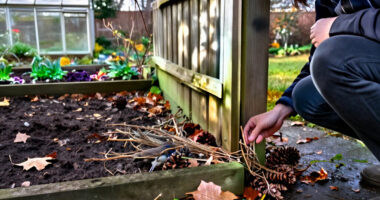
Hang lights so cords do not cross walkways and bulbs stay clear of dry leaves, fabric, and other materials, following the manufacturer’s placement instructions. LEDs usually produce less heat than traditional incandescent bulbs, but that does not make it sensible to bury bulbs under a wreath or tuck them into crunchy leaves. Good spacing keeps the display visible and reduces snagging. It also means a guest can see where the light ends and the path begins, rather than stepping over a wire hidden in the glow.
Picture a walkway lined with pumpkins and dried corn stalks. If a low strand crosses the path, someone carrying a pie may catch a foot on it; if bulbs press against dry stalks, the arrangement may not match the product’s safety directions. Raise the lights along the fence or railing instead, and keep the path itself open and easy to see. Moving the strand to the edge preserves the seasonal framing while avoiding a trip point where guests are likely to carry plates or look toward the decorations.
Use clips that hold the wire without crushing it, and secure the strand so guests cannot pull it down while reaching for a door handle. If children or pets will be outside, place lights and cords beyond their reach where practical, and keep small bulbs or detachable pieces away from curious hands and mouths. Plants and seasonal decorations can also be unsuitable for children or pets to chew, so place them thoughtfully. The goal is a display that stays in place during normal movement, since a dangling cord can become both a snag and an invitation to tug.
A timer can help you manage the evening: set it to switch on around dusk and off after guests head inside. It saves you from remembering the porch switch while carrying leftovers, and it avoids leaving lights on longer than intended. Before the gathering, check that the timer and any smart controls are approved for outdoor use and work within the expected temperature range. This convenience depends on a compatible timer and a schedule that matches the event; a simple switch remains easier if you expect to adjust the lighting frequently.
Choose between plug-in, battery, and solar power with November in mind
Choose plug-in lights for a dependable connection near an outdoor outlet, battery-powered lights where outlets are out of reach, and solar lights where the panel can get useful daylight. Each option solves a different problem, so the layout and November weather matter as much as the look. Shorter days, shade, and clouds can reduce solar charging and evening runtime. In practice, that means matching the source to the time you need the display: a short welcome at dusk may suit solar, while a long dinner calls for power you can count on for the full evening.
| Power source | Works well when | Check before buying |
|---|---|---|
| Plug-in | An outdoor outlet is close to the display | Outdoor rating, cord route, and connection limits |
| Battery | You need lights far from an outlet | Battery type, replacement access, and expected runtime |
| Solar | The panel can sit in a sunny, open spot | Charging conditions and seasonal runtime |
Say you want to light a shaded fence at the back of the garden. A solar panel there may get only a thin slice of afternoon sun, so the lights may fade before dessert. A battery-powered strand could be more reliable for a single evening, while a plug-in setup may make sense if a safe, outdoor-rated supply is nearby. Battery power avoids a long cord across the garden, but you trade that convenience for checking charge and replacement access; a plug-in route gives steadier output only if it can be kept safely out of the way.
Compare the product’s listed brightness, color, controls, and replacement options as well as the power source. A timer or app feature can be useful, but check that it works outdoors and across your expected temperature range. If you use several strings, follow the stated connection limit rather than guessing from how many plugs fit together. A brighter strand may make a small entrance feel welcoming but overwhelm an intimate table, so match brightness to the viewing distance and use dimming only when the product supports it as installed.
Frequently Asked Questions
Can I leave Thanksgiving string lights outside in rain or snow?
Only if the lights, cords, and accessories are rated for the conditions and installed as their instructions direct. Check each product’s label and documentation, especially for exposed locations. If a product’s guidance does not cover the weather you expect, take it down or keep it out of that exposure.
How can I tell whether string lights are outdoor-rated?
Check the label and product documentation for explicit outdoor-use language and any weather or ingress-protection rating. Do the same for extension cords, timers, and connectors. A covered porch still needs products suited to their actual location and exposure.
Are LED or incandescent lights better for a Thanksgiving display?
LEDs generally use less electricity and last longer than incandescent lights, and they usually produce less heat. Compare the specific product’s brightness, color, price, and replacement options. Keep any type of bulb clear of dry leaves and follow its placement instructions.
Will solar string lights work well in November?
They can, but shorter daylight hours, shade, and cloudy weather can reduce how much they charge and how long they shine. A sunny panel location improves their chances. For a shaded garden or a long evening, battery or plug-in lights may better fit your needs.
How many lights or strands do I need, and can I connect them?
Measure the route you want to cover, including the distance to the outlet and any gentle curves. Compare that measurement with the lighted length and lead length listed for the product. Connect strands only when the instructions allow it, and stay within the manufacturer’s stated limit.
How do I hang lights without damaging my house or trees?
Use clips, hooks, or ties designed for the surface, and avoid nails or staples that could puncture a wire. Secure strands so guests cannot snag or pull them down. On trees, avoid tightly constricting branches; a relaxed drape keeps the display tidy.
Conclusion
Start with the route guests will take and the place where they’ll gather. Measure it, choose outdoor-rated lights and cords for the conditions, then hang a warm, even glow with clips that keep wires clear of doors, dry leaves, and feet.
When dusk settles and the pumpkins catch that first amber light, your yard feels like part of the celebration. Make the path easy to follow, leave the table room to shine, and let the evening unfold under a little autumn glow.