
TL;DR

Get garden gear delivered free — and shop member deals
- Fast, free delivery on millions of items
- Access to Prime Big Deal Days deals on October 6–7
- Prime Video, Amazon Music and more included
A Gardener’s Path guide recommends renovating strawberry plants, applying a balanced fertilizer, watering until the first frost and adding mulch later in the season. The timing and method depend on plant type and local conditions; the report says temperatures of 15°F or below can cause fatal crown damage.
A Gardener’s Path report lays out four steps for preparing strawberries for winter: renovate the plants, fertilize, keep watering until the first frost and apply mulch after cold weather sets in. The guidance matters to gardeners in places where the ground freezes, because winter conditions can damage strawberry crowns, roots and next season’s buds.
The report advises gardeners to start with renovation after the final harvest, while tailoring pruning to the strawberry type. June-bearing plants can have their foliage cut to one to two inches above the crown. In larger patches, the report says mowing may be used at that height, but no more than a week after the last harvest, to avoid damaging new leaves. Matted plants should be thinned, and weeds, debris and unwanted runners removed.
For everbearing and day-neutral varieties, the guidance is less extensive: remove damaged, diseased or pest-infested leaves and thin plants to about five per square foot, or roughly four to six inches apart. Diseased or infested material should go in the trash rather than the compost, the report says. It also recommends applying a balanced 10-10-10 fertilizer at least a month before the area’s average first frost date, following the stated rate of five pounds per 100 feet of row or one pound per 25 plants. Keep granular fertilizer off foliage and water it in.
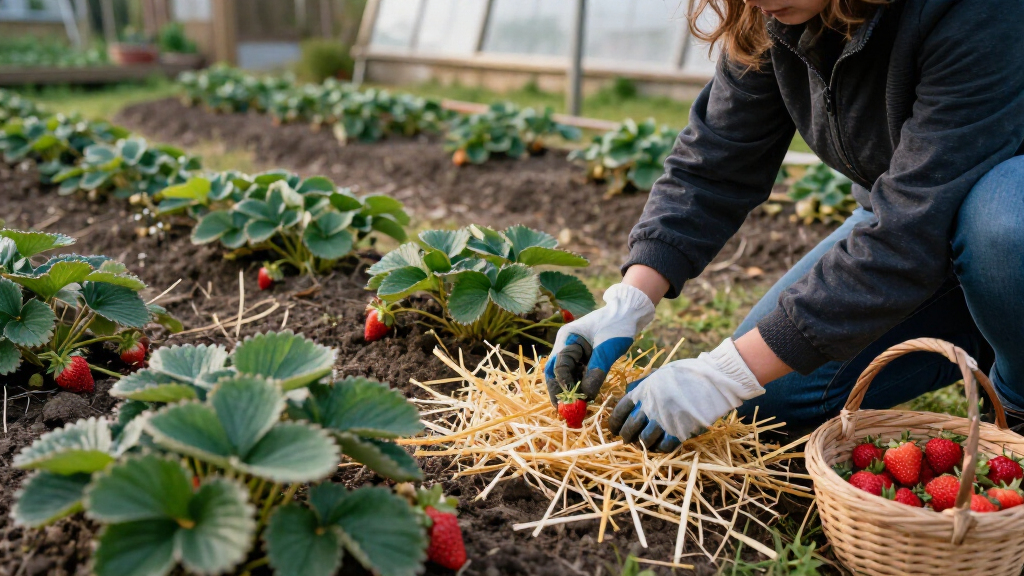
Continue to provide about one inch of water per week when rain is insufficient, up to the first frost. For garden beds, the report advises applying mulch after the first frost, generally in late November or early December, but before temperatures fall below 20°F. It warns against applying mulch too early, when warmth and trapped moisture may encourage new growth or crown rot.
Winter Protection for Strawberry Crowns
The recommendations address several ways winter can affect a strawberry planting. According to the report, mulch helps keep plants at a more consistent temperature, retain moisture around the crown and limit heaving—when freeze-thaw cycles shift soil and push plants upward. It can also help protect buds that would otherwise produce the next crop.
The report cites University of Minnesota Extension horticulturalist Emily Hoover as saying temperatures of 15°F or below can cause fatal crown damage. That risk is relevant to gardeners hoping to keep perennial strawberry plants from year to year, rather than treating them as annuals. The report says strawberries can be grown as perennials in USDA Hardiness Zones 3 to 10, while noting that cold-region gardeners sometimes discard plants at season’s end.
These are general seasonal recommendations, not a guarantee that every planting will survive winter. Local weather, snow cover, cultivar hardiness and the condition of the plants can all affect results; the source does not quantify how much protection the steps provide.
strawberry plant winter protection mulch
As an affiliate, we earn on qualifying purchases.
As an affiliate, we earn on qualifying purchases.
Care Depends on Strawberry Type
The report distinguishes three strawberry categories. June-bearing varieties form buds in fall and produce one main harvest, usually in June. Everbearing varieties can produce three harvests, while day-neutral plants may flower and fruit through the growing season when temperatures remain between 35°F and 85°F. Because their growth patterns differ, the report gives June-bearing plants a more substantial post-harvest pruning than it does everbearing and day-neutral types.
Strawberries need a period of cool temperatures for fruit production. The report says most types require 200 to 300 chill hours at temperatures between 45°F and 32°F for optimal production. That chilling requirement is distinct from protection against damaging cold: the guidance identifies 15°F or below as a potential crown danger, particularly when plants lack mulch or snow cover.
For strawberries grown in containers, the report says gardeners can use the same preparation steps and then move pots to a basement, shed or garage for winter. Container plants kept in a cold shelter need only enough water to keep the soil from drying out completely, according to the guidance.
“Temperatures of 15°F or below can cause fatal damage to the crown.”
— Emily Hoover, extension horticulturalist at the University of Minnesota Extension, as cited by Gardener’s Path
garden fertilizer 10-10-10 for strawberries
As an affiliate, we earn on qualifying purchases.
As an affiliate, we earn on qualifying purchases.
Local Conditions Shape Winter Risk
The source offers general advice but does not specify a single mulch depth or material in the available report text. It also does not give cultivar-by-cultivar cold tolerances or account for local variations in snowfall, soil drainage and frost dates. The suggested late-November-to-early-December mulch window is therefore not a fixed calendar rule: the report ties application to the first frost and says it should happen before temperatures fall below 20°F.
It is also unclear how much any one step changes survival rates. The report describes the practices as ways to help plants weather winter, but provides no comparative trial data. Gardeners should use local frost dates and conditions to judge timing rather than treating the stated dates as universal.
As an affiliate, we earn on qualifying purchases.
Follow Frost and Soil Conditions
For gardeners following the report’s schedule, the next steps are to finish post-harvest cleanup, apply fertilizer at least a month before the usual first frost, and keep garden plants watered until frost if rainfall is inadequate. After the first frost, monitor forecasts and add mulch before temperatures drop below 20°F, generally in late November or early December.
Container growers can prepare plants in the same way and move them to a cold sheltered space, checking occasionally that the soil has not dried out completely. Once winter passes, gardeners can assess plant survival and resume seasonal care as new growth appears. The source does not provide a specific spring inspection date or a forecast for any particular region.
As an affiliate, we earn on qualifying purchases.
Key Questions
When should I mulch strawberry plants for winter?
The report recommends waiting until after the first frost, when much of the foliage is brown and floppy, and applying mulch before temperatures fall below 20°F. It gives late November to early December as a general window, subject to local conditions.
Should all strawberry varieties be pruned the same way?
No. The report recommends cutting June-bearing foliage to one to two inches above the crown after harvest. For everbearing and day-neutral plants, it advises removing damaged, diseased or pest-infested leaves and thinning plants rather than cutting back all foliage in the same way.
How much should I water strawberries before winter?
In the absence of rain, provide about one inch of supplemental water per week until the first frost, according to the report. Garden plants do not need supplemental irrigation during dormancy. Container plants kept in a cold shed or garage need only enough water to prevent the soil from drying out completely.
Can strawberry plants survive in containers over winter?
The report says container-grown plants can be prepared using the same general steps and then placed in a basement, shed or garage. It recommends minimal watering in the cold shelter so the soil does not dry out completely.
Source: rss
Halloween Picks
halloween
As an affiliate, we earn on qualifying purchases.